
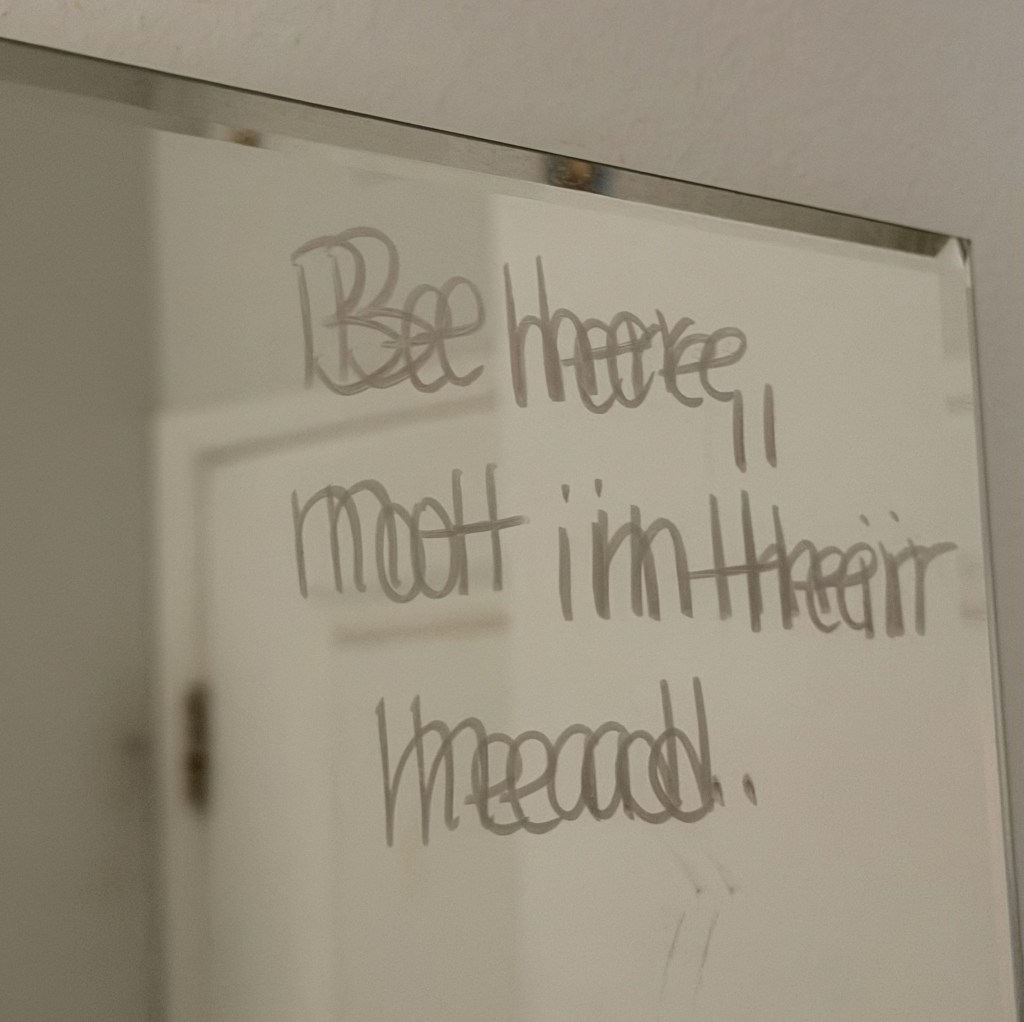
A while ago, I wrote a reminder to myself on my mirror:
Be here, not in their head.
Last night, I heard Peter Crone make a distinction that gave those words a whole new meaning. He pointed out that when we say we’re worried about what other people think of us, what we’re really worried about is what we think other people think of us.
And yes, the truth is, most of the time, I don’t actually know.
And I realized I do this constantly.
I’ve noticed it especially lately as I’ve started sharing more of myself online.
My Instagram originally grew around my boys… books, play, child-led learning, things we were doing together. Somewhere along the way, though, I started wanting to share more of me, too. The things I’m interested in… what I’m learning, wearing, creating… sometimes simply a photo of myself that I like.
And weirdly, that last one can feel incredibly vulnerable.
I can post a photo and genuinely like it and then suddenly find myself wondering what someone else thinks about the fact that I posted it.
Do they think I’m posting too many pictures of myself? Do they think I’m looking for attention? Do they think I’m self-absorbed?
Except… nobody actually said any of those things.
I did.
I put the thoughts in their heads and then started reacting to them as though they were real.
Which made me wonder… if those are the thoughts I automatically imagine other people having about me, maybe they’re telling me something about the ways I’m still judging myself.
Not necessarily what they think of me.
What I’m afraid they might think of me.
But I’ve also started noticing another way I do this.
Sometimes when I think I’m imagining what another person is thinking, I’m actually imagining what I would be thinking if I were behaving the way they are.
Social media reactions are a perfect example.
I’m someone who tends to use likes and hearts as little gestures of support. If a friend shares something, I’m likely to heart it, not necessarily because I have some strong opinion about that particular Story, but because the heart can mean I see you. I’m here. I support you.
So when someone I care about sees something I share and doesn’t react to it, my brain can very quickly translate that absence using my own language.
If I saw this and didn’t heart it, what would that mean?
And before I know it, I’ve answered the question for them.
Recently, I was with someone I love who kept enthusiastically showing me videos from a creator she thought was hilarious. Video after video… she quite obviously loved this woman’s content.
At some point I noticed something funny.
She wasn’t even following her.
When I pointed it out, she was genuinely surprised. She hadn’t decided not to follow her. She hadn’t watched all those videos while secretly disliking her. It apparently hadn’t even occurred to her.
And suddenly I thought… oh!
Not all people use social media the way I do.
And I’ve actually experienced the opposite side of this too!
I tend to heart my friends’ Stories as a way of showing support. To me, a heart doesn’t always mean I like what is happening here. Sometimes it simply means I see you. I’m here. I care.
Once, a friend shared something about going through an incredibly difficult time and I hearted the Story. She initially thought my reaction meant I somehow liked what she was going through.
And of course, that wasn’t what I meant at all!
Same heart. Completely different interpretation.
Which made me realize how strange it is that I can assign such specific meanings to other people’s reactions (or lack of reactions) when I’ve already experienced firsthand how easily the exact same little symbol can mean something completely different to two people.
And obviously, this isn’t really about Instagram.
Social media just happens to give me a very visible place to catch myself doing something I probably do in all kinds of relationships…
I observe something, interpret it, and then somewhere along the way I forget that my interpretation wasn’t part of the observation.
Someone says less than usual, doesn’t respond the way I expected, their tone feels different, they don’t ask a question I thought they would …
Those things may be real, but the story I attach to them may not.
I don’t think this means I should ignore how people treat me either. Sometimes there really is a pattern worth paying attention to or something that doesn’t feel good … and I can decide what I want to do with that.
What I don’t have to do is fill in all the blanks.
I can notice that someone is acting differently without deciding I know why. I can be hurt or disappointed by something without creating an entire explanation for what must be going on in their head.
And if I really need to know, I can always ask.
Otherwise, maybe I can just let the part I don’t know stay unknown.
Which brings me right back to the thing I wrote on my mirror:
Be here, not in their head.
I think “here” is just what’s actually here… what happened, how I feel about it, and what I want to do next.
Everything else might just be a story I’m telling myself.
Of course, realizing I do this doesn’t mean I’m suddenly going to stop doing it. 😂
I’ll probably still catch myself wondering what someone meant, why they didn’t respond, what they thought of something I shared, or whether I did something wrong.
But maybe that’s the practice…
Catching myself when I’ve wandered out of my own life and into someone else’s head, and then coming back to what I actually know, what’s currently happening right here, right now… back to myself.
Be here, not in their head.


Leave a Reply